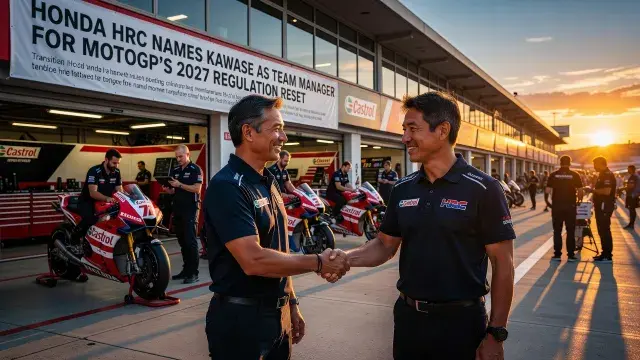
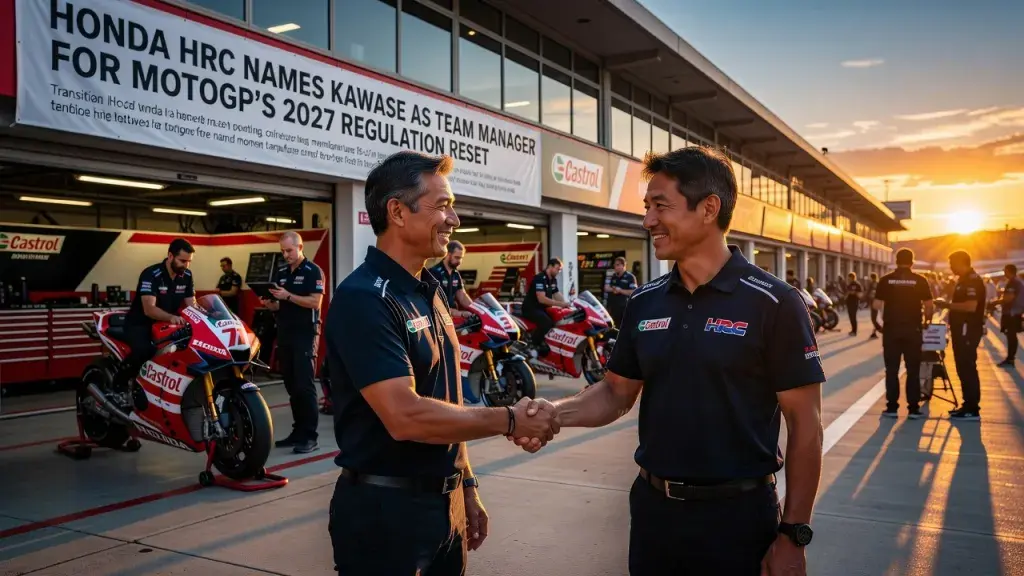
Honda HRC Castrol has confirmed Mikihiko Kawase as its Team Manager for the 2027 MotoGP season, promoting the current Technical Manager into the top operational role as the championship approaches its most significant regulatory overhaul in decades. Alberto Puig, who has led the team as manager for a number of years, will step back from the day-to-day role and transition into an advisory position, remaining on hand to support Kawase through the transition.
The announcement marks a deliberate generational handover within one of Grand Prix motorsport's most storied operations. Kawase, who was appointed Technical Manager of the MotoGP project in 2024, brings with him a career that stretches back to the paddock trenches rather than the boardroom - a background that stands in contrast to some leadership appointments across the premier class. Much as fans of other precision sports consult field hockey odds to gauge competitive form and momentum, Honda's decision here reflects a calculated read of where the team's best prospects lie heading into a transformative era.
A Life Built Around Racing
Kawase's path to the top of Honda HRC is anything but conventional. He competed in lightweight categories in Japan from the age of 18 through to 27, funding his riding career by working for various component manufacturers before eventually joining Honda. The combination of lived experience as a competitor and technical expertise as an engineer gives him a perspective that is relatively rare at team manager level in MotoGP.
Following a transfer to Honda HRC in 2012, he threw himself into the Moto3 World Championship project and, as Large Project Leader for the NSF250RW, guided Honda to the lightweight world title in 2019. That success earned him a move into the MotoGP programme, where he has since worked to arrest the manufacturer's well-documented decline in the premier class. His elevation to Technical Manager in 2024 was widely read as preparation for greater responsibility - and this confirmation delivers on that expectation.
Puig Steps Back, but Does Not Disappear
Alberto Puig's shift to an advisory role closes a significant chapter at Honda HRC. A former Grand Prix rider himself, Puig has been a fixture in the upper reaches of the Honda structure and was instrumental in signing and managing Marc Márquez during the Spaniard's dominant years with the manufacturer. His transition to advisor rather than outright departure ensures that institutional knowledge - of the paddock's politics, of manufacturer relationships, of how to manage elite riders under pressure - remains available to Kawase as he finds his footing.
Kawase acknowledged that dynamic directly, describing Puig as a mentor who has already shaped his thinking over many years. "I must thank Honda for this opportunity and also Alberto Puig, who has already been a great mentor and adviser to me for many years," he said. "The support of both will be fundamental to the team's future success."
Why 2027 Makes This Appointment Matter
The timing of this announcement is not incidental. MotoGP's 2027 regulations represent the most sweeping technical reset the championship has undertaken since the transition from two-stroke to four-stroke engines - a shift that rewrote the competitive order and produced a new generation of dominant manufacturers. Every team on the grid is effectively starting from a modified baseline, which means the advantage held by established hierarchies is, at least in part, neutralised.
For Honda, who have endured a prolonged and painful period of underperformance relative to their historical standards, 2027 represents a genuine opportunity to rebuild competitive relevance. Putting Kawase in charge now - rather than at the start of the season itself - gives him time to shape the team's internal culture and operational approach before the new machines take to the track. Whether Honda can translate that preparation into results against a Ducati-dominated field, and an increasingly competitive KTM and Yamaha, remains the central question hanging over the project. Kawase inherits both the weight of Honda's legacy and the complexity of restoring it.