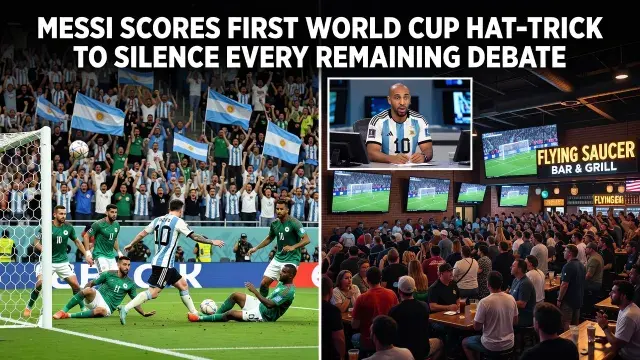
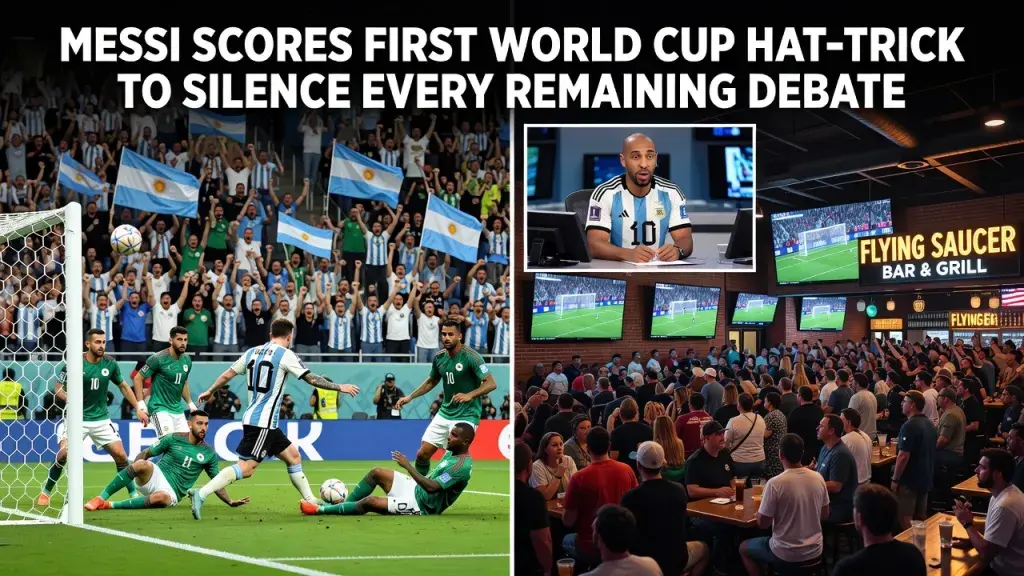
Lionel Messi delivered the most emphatic reminder yet of his singular standing in the sport, scoring a World Cup hat-trick against Algeria in Kansas City to equal the all-time record for goals at the tournament's final stage. He will turn 39 next week. Nobody in that stadium, or in the millions watching around the world, appeared to care. The GOAT, as the acronym goes, is not done writing history.
Thierry Henry, a man who spent the better part of two decades operating at the summit of world football, was reduced to near silence by what he witnessed. "I don't know what to say anymore," Henry admitted. "What is left to say?" It is a fair question, and one that grows harder to answer with each successive Messi performance. For those who prefer to bet georgia on their own sporting passions rather than watch football, last night's events in Kansas offered a compelling argument for reconsidering priorities. In the Flying Saucer bar and grill in downtown Houston, hundreds abandoned whatever else they had planned for the evening and fixed their eyes on a television screen showing a 38-year-old man making professional international footballers look like they had never played the game before.
Messi now has 16 World Cup goals, equalling a record that stood as the benchmark for tournament-level excellence. He scored them across a span that began two decades ago - and this hat-trick arrived, with the kind of symmetry that scriptwriters would reject as too contrived, on the precise anniversary of that first World Cup goal. The tournament's record now sits within reach, and on this evidence, it is difficult to construct a serious argument for why he will not surpass it.
Above Ronaldo, Above the Debate
The conversation about Messi and Cristiano Ronaldo has consumed football media for the better part of fifteen years. It has been entertaining, occasionally illuminating, and mostly unnecessary. Messi has now rendered it entirely redundant. Ronaldo is a generational talent. Messi is something else. Before this tournament, Kylian Mbappe and Erling Haaland had both made compelling cases for their own claims to the next era of the sport. Messi, in a single match, reframed the entire conversation. That is not a slight on Mbappe or Haaland - both are exceptional. It is simply an acknowledgement of where Messi sits relative to everyone else who has ever played the game.
If football had its own Mount Rushmore, the argument about whose face belongs on it would be the only debate worth having. Pelé, Maradona, Cruyff - names carved into the sport's bedrock. Messi's place among them was already settled. What he continues to do now is push further beyond any reasonable frame of comparison. When Diego Maradona took down England single-handedly at the 1986 World Cup in Mexico, Steve Hodge walked away from the final whistle holding a shirt that would eventually be sold for close to ten million dollars. Any shirt belonging to Messi, any opponent fortunate enough to make that exchange at the end of ninety minutes, already knows what they are holding is beyond price.
What Messi Does to a Room, a City, a Sport
Americans are not a football nation. Baseball, basketball and the NFL occupy the sporting consciousness here, and football - or soccer, as the polite correction goes - remains a peripheral concern for most. Last night in Houston, that was not the case. The bar emptied when Messi came off, which is the most honest measure available of how much he had mattered to the people watching. He did not just win a football match. He temporarily reorganised the sporting priorities of people who do not ordinarily follow the sport. That is a rare and specific kind of power, and it belongs almost exclusively to him.
He could have retired after 2022. Argentina's World Cup triumph in Qatar was the final chapter that his legacy had always seemed to be missing - the crowning of a career already defined by every other honour the game could offer. He chose not to stop. Whether that decision was driven by hunger, love of the game, or simply the belief that there was more still to give, the result is the same: the sport is richer for it, and everyone watching is fortunate to still be in the room. His name will be etched into footballing folklore for as long as the sport is played. Right now, with sixteen World Cup goals and counting, he is still adding to the inscription.