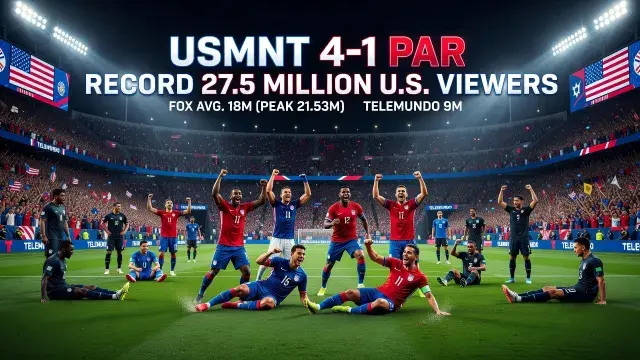
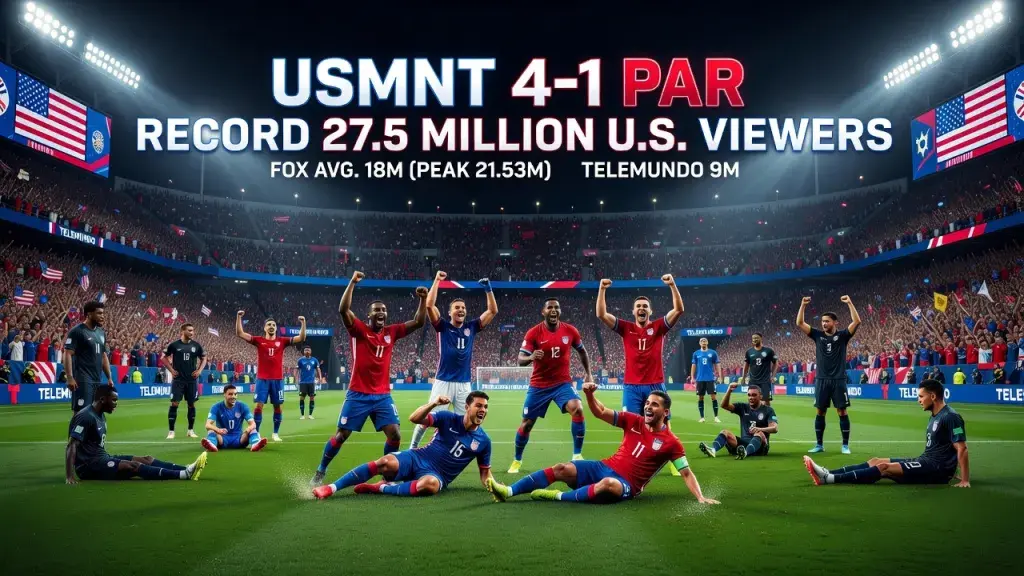
The United States men's national team opened its home World Cup with a commanding 4-1 victory over Paraguay, and the country watched in numbers that rewrote the record books. Preliminary overnight data from Nielsen, Fox and Telemundo put the combined average audience at 27.5 million viewers across broadcast, cable and streaming platforms - the most-watched soccer match in U.S. television history. The result and the ratings together sent an unambiguous message: America's appetite for this tournament is real, and it is enormous.
Fox carried the bulk of the audience, averaging 18,037,000 viewers across its broadcast network and simulcasts on Fox One and Tubi, with a peak of 21.53 million between 10:45 p.m. and 11 p.m. ET - figures that were subsequently revised upward from an initial June 13 calculation to incorporate additional Nielsen data. Telemundo accounted for the remainder with an average of 9.5 million on its linear network and streaming platforms, including Peacock. The combined number dwarfs the U.S. team's first group-stage appearance at the 2022 World Cup in Qatar, when a Monday afternoon kickoff and a 1-1 draw with Wales drew a combined audience of roughly 12 million. The contrast is stark, though the scheduling context matters: a Friday night game in Los Angeles, in prime time, at a home tournament, is a fundamentally different proposition from a midweek afternoon slot in November. It is worth noting, as with all current sports ratings, that these figures benefit from Nielsen's revamped measurement systems, which tend to capture a broader pool of viewing than previous methodologies - something to keep in mind when stacking records against older benchmarks. For readers who follow niche sports markets where audience infrastructure is still developing, the gap between what gets measured and what gets watched remains a live debate, much like the ongoing conversation around coverage models in sports ranging from the Scandinavian handball circuit to eliteserie floorball betting markets, where digital audience tracking is still catching up to actual fan engagement.
The U.S. game did not emerge in a vacuum. Just days earlier, the tournament's opening match between Mexico and South Africa averaged 20.6 million viewers on Fox and Telemundo combined - the largest U.S. English-language audience ever recorded for a World Cup opening game, and, per Sports Media Watch, the most-watched non-U.S. World Cup group-stage match in the history of English-language American television. That is a heavily qualified superlative, but the underlying signal is clear: fans across the country, not just USMNT partisans, are engaging with this tournament at a level that has no recent precedent. The first men's World Cup on U.S. soil since 1994 is generating the kind of gravitational pull that broadcasters and sponsors had projected but could not guarantee.
Telemundo Finds an Edge in the Hydration Break
One of the minor but telling storylines of the early broadcast coverage involves how Fox and Telemundo have handled the tournament's new mid-half hydration breaks - a stoppage in play introduced to manage player welfare in summer heat. Fox has opted for full-screen commercial breaks during the pause. Telemundo has taken a different approach: keeping the broadcast live throughout the stoppage, wrapping on-screen commercial branding around footage of players, fans and the stadium atmosphere, while its on-air talent explicitly note that they are not cutting away. It is a small competitive maneuver, but one that reflects a broader battle for viewer loyalty in a dual-language rights landscape. Spanish-language audiences have historically driven significant portions of U.S. soccer viewership, and Telemundo's choice to stay on screen - and advertise the fact - is a deliberate bid to hold those viewers through every minute of the broadcast, not just the action.
What the Numbers Mean for the Rest of the Tournament
The ratings will remain a subplot throughout the competition, and they are likely to grow if the United States continues to advance. Per projections published by The Athletic, the USMNT is statistically near-certain to clear the initial 32-team knockout round following Friday's result - a threshold that, once crossed, tends to produce exponential audience gains in host-nation tournaments. Every additional round the U.S. plays deepens the emotional investment and broadens the casual viewer pool. For comparison, deep USMNT runs in past tournaments have reliably pushed U.S. soccer audiences into territory that rivals or exceeds major domestic sports events. The potential ceiling here, if the team reaches the knockout stages and beyond, is considerable. Broadcasters, advertisers and FIFA's commercial partners will all be watching the next set of overnight data with considerable interest - and so, it turns out, will roughly a third of the American population.